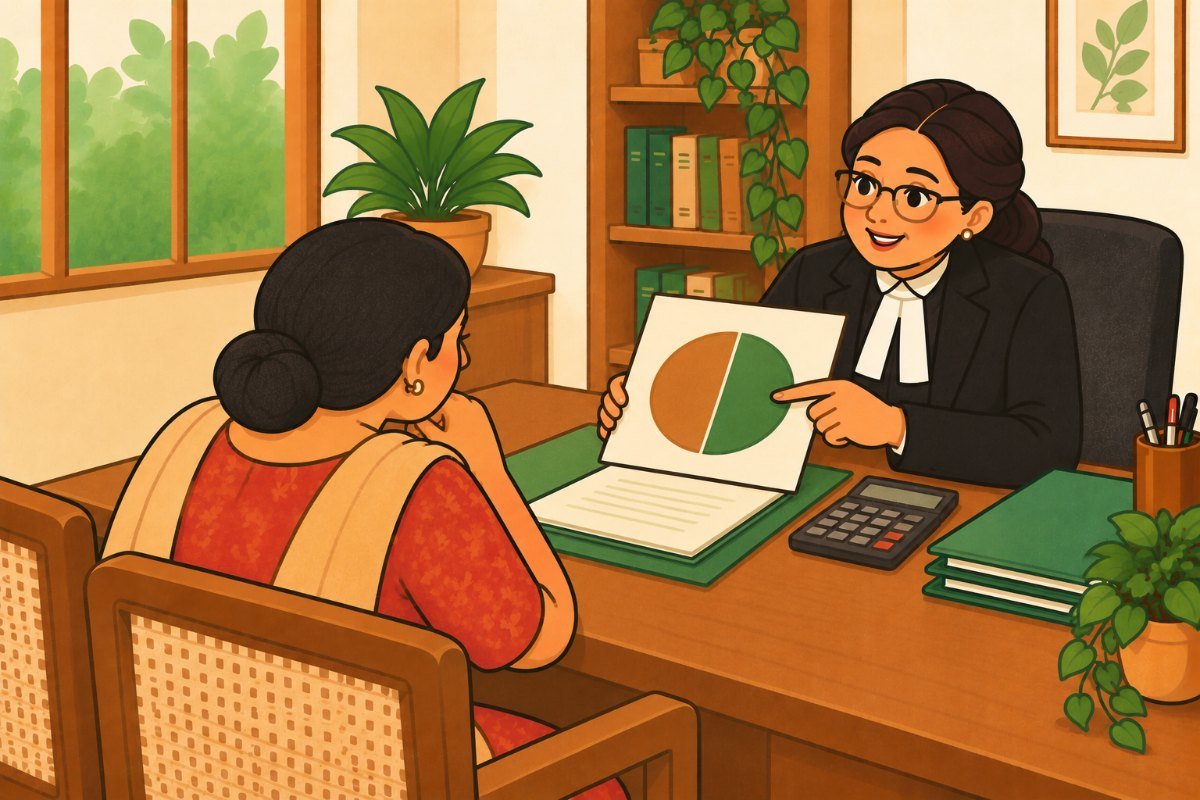
“How much maintenance will I get?” is usually the first question a woman asks when her marriage breaks down. There is no fixed formula in the law, but the Supreme Court has laid down clear guidelines on how courts work it out, what both spouses must disclose, and from when maintenance is paid. This guide explains them.
Key facts
- Laws
- Section 144 BNSS (any religion); Sections 24 and 25, Hindu Marriage Act; Section 20, Domestic Violence Act; personal and special laws
- Benchmark
- 25% of the husband’s net salary has been treated as just and proper (Kalyan Dey Chowdhury v. Rita Dey, 2017); it is a guide, not a rule
- Disclosure
- Both spouses must file an affidavit of assets, income and liabilities (Rajnesh v. Neha, 2020)
- From when
- Ordinarily from the date the application was filed
- Interim maintenance
- Under Section 24 HMA, to be decided as far as possible within 60 days of notice
Which law gives maintenance
- Section 144, Bharatiya Nagarik Suraksha Sanhita (earlier Section 125 CrPC): for a wife unable to maintain herself, against a husband with sufficient means who neglects or refuses to maintain her. It applies to women of every religion; in 2024 the Supreme Court confirmed it is available to divorced Muslim women too. A divorced wife counts as a wife until she remarries. Section 144 explained.
- Hindu Marriage Act: Section 24 (maintenance and litigation costs while the case is pending) and Section 25 (permanent alimony). These apply to either spouse.
- Domestic Violence Act, Section 20: monetary relief, including maintenance, in a domestic violence case.
- Muslim women: besides Section 144, a divorced woman is entitled to a fair and reasonable provision under the Muslim Women (Protection of Rights on Divorce) Act, 1986, and to unpaid mehr.
How courts decide the amount
In Rajnesh v. Neha (2020), the Supreme Court listed what courts must consider:
- the status of the parties and the standard of living during the marriage;
- the reasonable needs of the wife and the children, including education and medical costs;
- the wife’s own income, qualifications and whether she gave up work for the family;
- the husband’s income, assets, liabilities and other dependants;
- the duration of the marriage and inflation.
In Kalyan Dey Chowdhury v. Rita Dey (2017), the Court treated 25% of the husband’s net salary as a just and proper amount of maintenance for the wife. It is a benchmark, not a ceiling or a floor; children’s maintenance is considered separately, and the amount depends on the facts.
Disclosure: no more hiding income
Both husband and wife must file an affidavit of disclosure of their assets, income, expenses and liabilities, in the format the Supreme Court prescribed. A false or incomplete affidavit can lead to action for perjury. If you suspect the husband is hiding income, collect what you can: salary slips, bank statements, income tax returns, business records, property papers, lifestyle evidence.
From when, and overlapping claims
- Maintenance is ordinarily awarded from the date of the application, not from the date of the order.
- If a woman has claims under more than one law, the court adjusts the amounts so that she is not paid twice for the same need; she must disclose earlier orders.
If the husband does not pay
An order for maintenance can be enforced: the court can attach his salary or property, and for unpaid maintenance under Section 144, issue a warrant to recover it, and sentence him to imprisonment for non-payment. Keep a record of every payment and every default.
Example
A husband earns Rs 80,000 a month after tax and has no other dependants. Using the 25% benchmark, the court may start around Rs 20,000 a month for the wife, then adjust for her own income, the children’s needs, his loans and the family’s standard of living. This is an illustration only.
Related: divorce for women in Mumbai, a wife’s rights in divorce, documents to collect before filing.
Preparing the affidavit? The free maintenance affidavit helper takes you through every part of the Rajnesh v. Neha format and builds a printable draft.
Consultations are by appointment at the chambers in Malwani MHADA, Malad (West). To fix a time, telephone +91 99301 50560 or send a message on WhatsApp.
This guide describes the general position as understood in October 2026. The amount of maintenance depends on the facts and the court’s assessment. It is not legal advice.