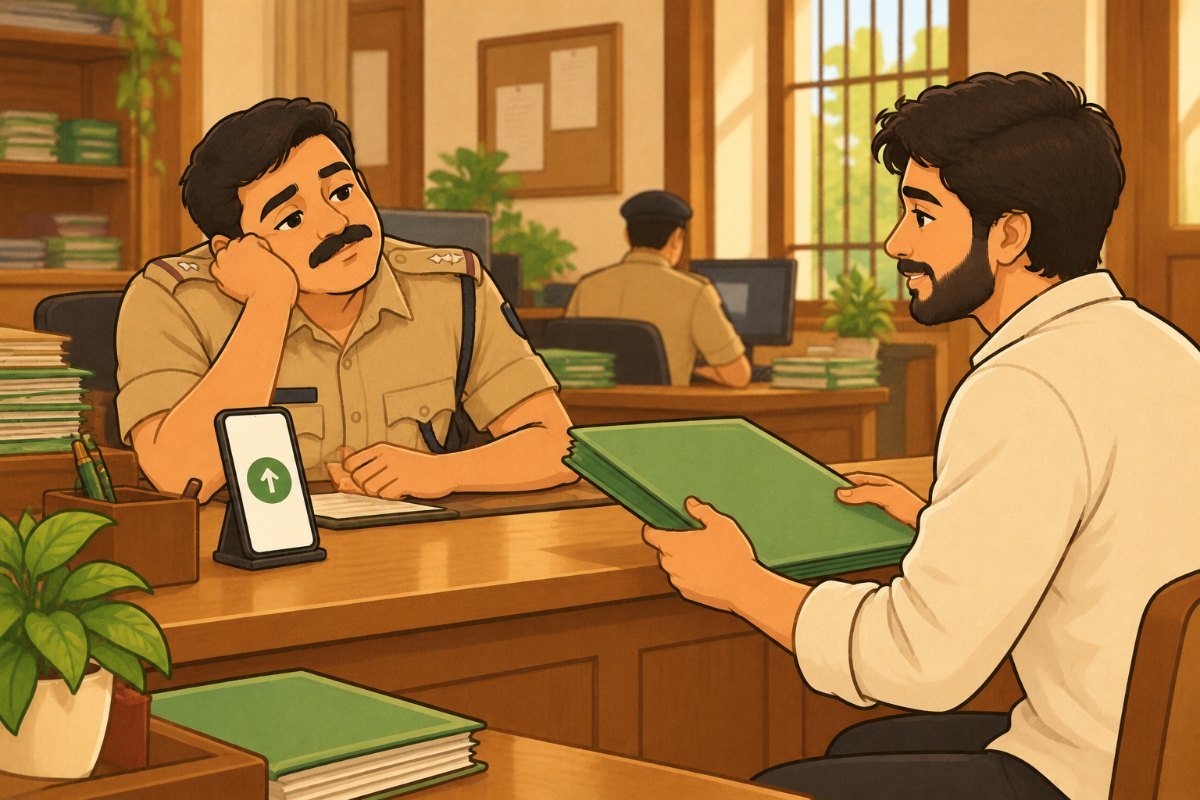
When a cognizable offence has been committed, the police are bound to register a First Information Report (FIR). The Supreme Court said so firmly in Lalita Kumari v. Government of Uttar Pradesh (2013), and the Bharatiya Nagarik Suraksha Sanhita, 2023 (BNSS), in force from 1 July 2024, now sets out the procedure in Section 173. Yet people are still sent away, told to “settle it”, or handed a non-cognizable receipt instead. This guide explains your rights and what to do next.
First: is the offence cognizable?
| Cognizable offence | Non-cognizable offence | |
|---|---|---|
| Examples | Theft, cheating, assault causing hurt with weapons, cruelty to a wife, sexual offences | Simple hurt, insult, minor criminal intimidation |
| What police record | FIR under Section 173 BNSS | NC entry under Section 174 BNSS |
| Investigation | Police may investigate and arrest without a warrant | Police need a Magistrate’s order to investigate |
If the police give you an NC receipt for what is really a cognizable offence, you can insist on an FIR or use the remedies below.
Your rights under Section 173 BNSS
- Zero FIR. Information about a cognizable offence may be given at any police station, irrespective of where the offence took place. The police must register it and transfer it to the station with jurisdiction. “This is not our area” is not a reason to refuse.
- e-FIR. Information may be given by electronic communication. It is taken on record when the person giving it signs it within three days.
- Free copy. You are entitled to a copy of the FIR free of cost (Section 173(2)).
- Women complainants. Where the information concerns certain offences against women, it is to be recorded by a woman police officer.
- Progress updates. The police are required to inform the informant or victim of the progress of the investigation within 90 days (Section 193(3)).
When police may make a preliminary enquiry
For cognizable offences punishable with imprisonment of three years or more but less than seven years, Section 173(3) allows the officer in charge, with the prior permission of an officer not below the rank of Deputy Superintendent of Police, to hold a preliminary enquiry for up to 14 days to see whether there is a prima facie case. For offences outside that band, the FIR must be registered. Even within it, the enquiry is time-bound and cannot be used to delay indefinitely.
Remedy 1: the senior police officer, Section 173(4)
If the officer in charge refuses to record the information, you may send the substance of it, in writing and by post, to the Superintendent of Police. In Mumbai, which has a police commissionerate, this is addressed to the Deputy Commissioner of Police of the zone concerned (and may be copied to the Commissioner of Police). If satisfied that a cognizable offence is disclosed, the officer either investigates or directs an investigation.
Send it by registered post or speed post and keep the receipt and tracking record. You will need them for the next step.
Remedy 2: the Magistrate, Section 175(3)
If the senior officer also does not act, you can apply to the Magistrate under Section 175(3) BNSS asking for a direction to the police to investigate. The application must be supported by an affidavit, and must show that you first approached the senior officer under Section 173(4). The Magistrate may make such enquiry as is needed and hear the police before passing an order. Alternatively, a private complaint can be filed before the Magistrate.
How to write the complaint
- Your name, address and phone number.
- Date, time and place of each incident, in order.
- Who did what, naming each person and describing their acts.
- Witnesses and documents (messages, photographs, medical papers, bank records).
- Any loss or injury.
- A clear request: “Kindly register an FIR under Section 173 of the BNSS and investigate.”
Keep it factual and avoid exaggeration. Sign and date it, keep a copy, and ask for an acknowledgment with the station stamp.
Frequently asked questions
Can I file an FIR online in Maharashtra?
The BNSS allows information to be given electronically, and Maharashtra Police accept certain complaints through their citizen portal. An electronically given FIR must be signed within three days to be taken on record.
The police say they will “first enquire”. Is that allowed?
Only for offences punishable with three to less than seven years, with a senior officer’s permission, and for up to 14 days. Otherwise registration is mandatory.
Do I need a lawyer to file an FIR?
No. Anyone can give information to the police. Legal help is useful for drafting a clear complaint, for the Section 173(4) letter and for the Magistrate’s application.
I have been named in an FIR. What now?
See receiving a police notice and anticipatory bail.
See also: police complaint drafting and CrPC to BNSS section numbers.
Consultations are by appointment. To fix a time, telephone +91 99301 50560 or send a message on WhatsApp.
This guide describes general procedure as understood in October 2026. It is not legal advice; the facts of each case matter, so take advice before acting.