Cloned voices and face-swapped videos are now cheap to make. A “relative in trouble” call, a video message from a “senior officer”, or an obscene image carrying your face can all be fabricated from a few photos or a short audio clip. This guide explains how to protect yourself, what to do in the first hour, and where to report in India. It is general information, not advice on your particular case.
What these scams usually look like
- Voice-clone calls: a call that sounds like a son, daughter or friend, saying they are in an accident or in police custody and need money at once.
- Video-call impersonation: a “video” of a known person or an official asking you to transfer money or share an OTP.
- Morphed or fake intimate images: your face placed on another body, often followed by a demand for money. If this has happened to you, read what to do when someone threatens to leak photos or videos.
- Fake profiles: a social media account using your photos and name to ask your contacts for money.
Protect yourself before anything happens
- Call back on a number you already have. If a “relative” or “officer” asks for money, end the call and ring the saved number or another family member.
- Agree a family code word that only close relatives know, to be used in any emergency money request.
- Never share an OTP, UPI PIN or card details on a call or video call, whoever the caller says they are.
- Keep social media accounts private and limit who can see clear photos and videos of your face. Do not post voice notes publicly if you can avoid it.
- Turn on two-step verification on email, WhatsApp, Instagram and other accounts.
- Do not rush. Every one of these scams depends on urgency. A few minutes of checking breaks most of them.
Automated calls and robocalls
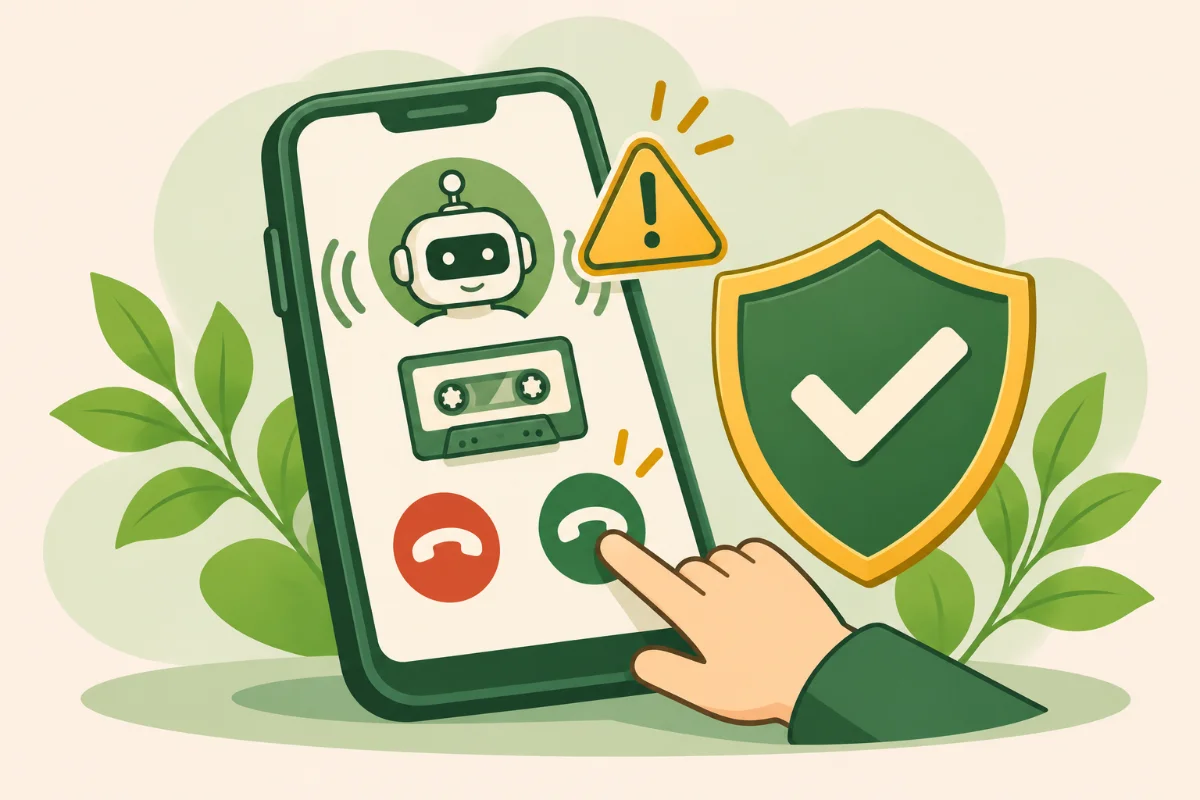
Many scam calls are now automated. A recorded voice, sometimes AI-generated, says your mobile number will be disconnected, your parcel has been seized, your bank account or card is blocked, or your electricity will be cut tonight, and asks you to “press 9” or stay on the line. You are then connected to a person who asks for an OTP, a payment, or for you to install an app.
- Hang up. Government departments, courier companies and banks do not threaten disconnection or arrest through recorded calls.
- Know how genuine calls look. Under TRAI’s rules, service and transactional calls from banks, insurers and other regulated financial companies come from numbers in the 1600 series, and promotional calls from the 140 series. A “bank” calling from an ordinary mobile number is a warning sign, though a 1600 number alone is not a guarantee.
- Never install an app or screen-sharing tool at a caller’s request.
- Call the organisation yourself on the number printed on your card, bill or its official website.
Fake investment videos of famous people
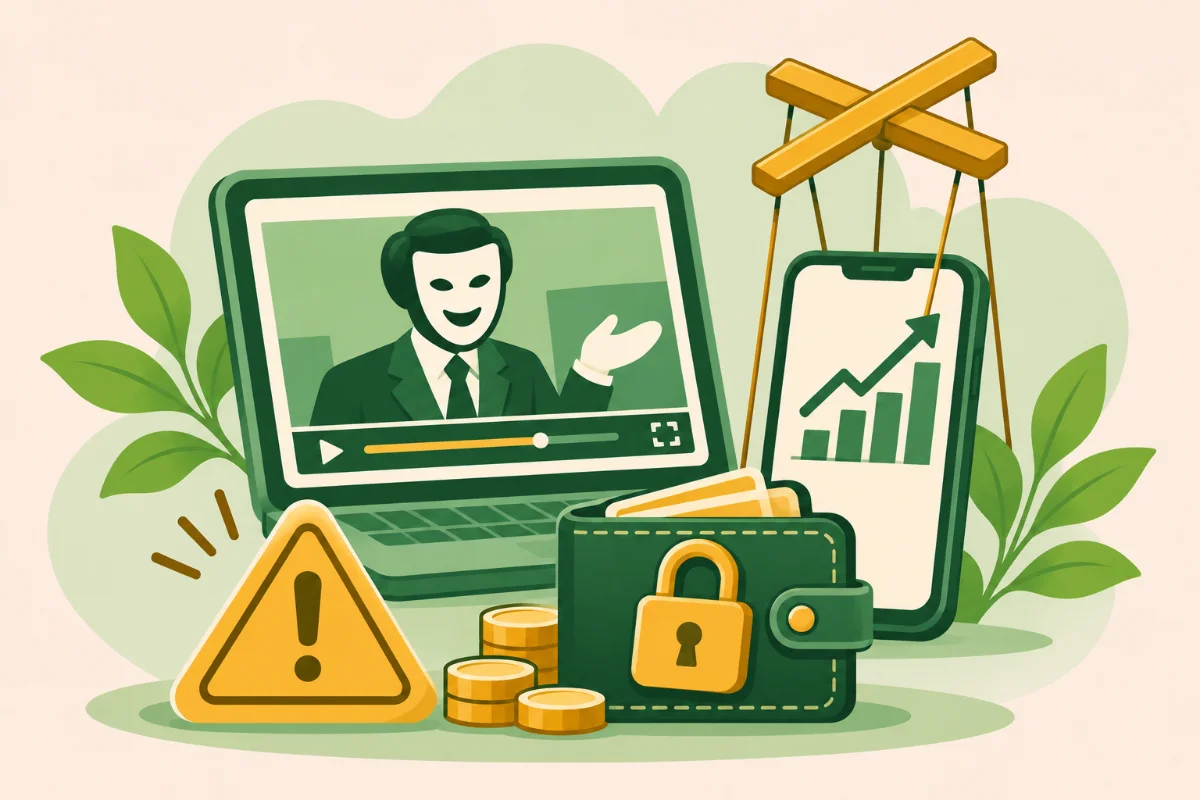
Deepfake videos of well-known businessmen, ministers, fund managers and stock exchange officials are being used in social media advertisements to promote “guaranteed” stock tips and trading apps. The Bombay Stock Exchange has repeatedly warned about fake videos of its chief executive, and SEBI has warned investors about deepfakes and invitation-only WhatsApp and Telegram trading groups. The pattern is usually the same: an advertisement, a private group full of fake members posting profits, a trading app that shows growing gains, and then withdrawals that are blocked until you pay “tax” or “fees”.
- A real expert or official will not recommend stocks in a WhatsApp or Telegram group.
- Check that any adviser or broker is registered with SEBI before you invest.
- Download trading apps only of SEBI-registered brokers, from official app stores, never from links or APK files.
- Promises of guaranteed or very high returns are the clearest sign of fraud.
Report a suspicious call before you lose money
If you receive a suspected fraud call, SMS or WhatsApp message but have not lost money, report it on the Chakshu facility of the Department of Telecommunications’ Sanchar Saathi portal (sancharsaathi.gov.in). Reports help the department act against the numbers used. Chakshu is for attempts; if money has already gone, call 1930 and file on cybercrime.gov.in as set out below.
If it has already happened: the first hour
- Stop engaging. Do not argue with the caller or send more money to “fix” it.
- Save the evidence. Take screenshots of messages, profile pages and URLs, and note phone numbers, dates, times, UPI IDs and bank account numbers. Do not delete chats.
- If money went out, call 1930 (the national cyber crime helpline for financial fraud) immediately. Speed matters. The steps are in what to do after a UPI fraud.
- Tell your bank in writing and ask it to block the transaction or hold the receiving account if it can.
- Report on cybercrime.gov.in. Choose the category that fits (financial fraud, or crimes related to women or children, or other cyber crime) and upload your evidence. Note down the acknowledgement number.
- Report the fake content to the platform (Instagram, Facebook, YouTube, X, WhatsApp) using its impersonation or non-consensual intimate image reporting option.
- Warn your contacts if a fake profile is using your name, so they do not send money.
Law that applies
| Situation | Provision commonly used |
|---|---|
| Using your identity, photo or voice dishonestly | Section 66C, Information Technology Act, 2000 (identity theft) |
| Cheating by pretending to be someone else using a computer or phone | Section 66D, IT Act, 2000 (cheating by personation using a computer resource) |
| Cheating by personation, offline or online | Section 319 (punishment in sub-section (2)), Bharatiya Nyaya Sanhita, 2023 |
| Cheating and dishonestly inducing delivery of property | Section 318, Bharatiya Nyaya Sanhita, 2023 |
| Publishing or sharing private or obscene images | Sections 66E, 67 and 67A, IT Act, 2000, as the facts require |
Which sections are finally applied is decided by the police and the court on the facts. For the old and new section numbers, see CrPC to BNSS section numbers explained.
Getting fake content taken down
The Information Technology (Intermediary Guidelines and Digital Media Ethics Code) Rules, 2021 require an intermediary to act on a complaint about content that shows a person in a sexual act or nudity, or that impersonates them, including morphed images. Since 20 February 2026, when the Information Technology (Intermediary Guidelines and Digital Media Ethics Code) Amendment Rules, 2026 came into force, Rule 3(2)(b) requires removal or disabling of access within 2 hours of receiving the complaint (it was 24 hours earlier). The same amendment covers AI-made audio, images and video, which it calls “synthetically generated information”, and requires platforms to label such content clearly. Use the platform’s reporting form first, keep the complaint reference, and mention it in your police complaint. If the platform does not respond, your lawyer can escalate the matter.
If the police do not take your complaint
You can file the report online, and you can also go to the cyber police station or the local station. If a station refuses to register a complaint, see police not registering an FIR: Zero FIR and e-FIR under the BNSS.
Common questions
Is making a deepfake of me a crime in India?
There is no single law named after deepfakes. Since February 2026 the IT Rules define AI-made audio, images and video as “synthetically generated information”, require platforms to label it and to remove unlawful deepfakes quickly, but punishment still comes from existing offences. The act is dealt with under existing provisions, such as identity theft, cheating by personation and the sections on obscene or private images, depending on what was done and why.
Should I pay to make it go away?
Do not pay. Payment usually brings further demands. Save the messages and report.
Can I recover money I sent?
Sometimes, especially if the transaction is reported through 1930 quickly and the money has not yet been moved on. There is no guarantee.
Where do I report if I am not sure which category fits?
File on cybercrime.gov.in under the closest category and describe the facts fully. The details you give matter more than the category.
See also: Sextortion of men and boys through fake girl profiles.
Sources
- National Cyber Crime Reporting Portal, Ministry of Home Affairs (cybercrime.gov.in), and the national helpline 1930
- Information Technology Act, 2000, Sections 66C, 66D, 66E, 67 and 67A (India Code)
- Bharatiya Nyaya Sanhita, 2023, Sections 318 and 319
- Information Technology (Intermediary Guidelines and Digital Media Ethics Code) Rules, 2021, Rule 3(2)(b)
- IT (Intermediary Guidelines and Digital Media Ethics Code) Amendment Rules, 2026, in force 20 February 2026 (Bar & Bench; 2-hour takedown for intimate and morphed images, Mondaq)
- Chakshu, Sanchar Saathi portal, Department of Telecommunications
- TRAI: 1600 series for service calls of banks and financial entities (Mondaq)
- BSE warns investors about deepfake video of its MD and CEO, March 2026 (Asianet Newsable)
- SEBI advisory on invitation-only WhatsApp trading groups, October 2026 (Open)
Related: bank account frozen after a cyber complaint · hacked social media account · digital arrest scam
This guide is general information and does not replace advice on your own situation.