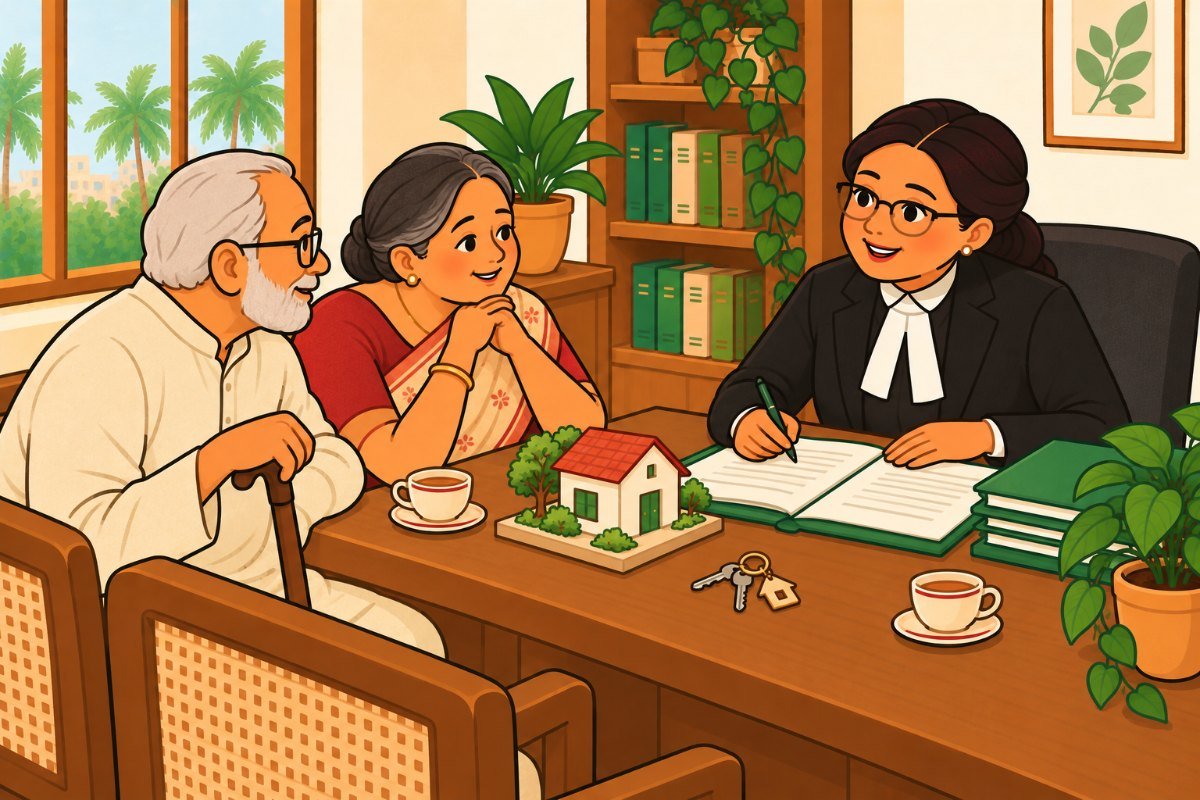
Many elderly parents in Mumbai live in a flat they bought themselves, while a son or daughter who moved in years ago refuses to look after them, or makes life in the house unbearable. Some parents gifted the flat to a child on the understanding that they would be cared for, and the care stopped. The Maintenance and Welfare of Parents and Senior Citizens Act, 2007 gives parents a quick remedy before a tribunal, without a long civil suit. This guide explains what it covers in Maharashtra, including the 2025 Supreme Court rulings on eviction and gift deeds.
Key facts
- Who can apply
- A parent of any age, or a senior citizen (60 or above)
- Against whom
- Adult children and grandchildren; for a childless senior citizen, the relative who will inherit the property
- Where
- The Maintenance Tribunal, headed in Maharashtra by the Sub-Divisional Officer (Revenue)
- Maintenance
- Up to Rs 10,000 a month (Section 9)
- Time limit
- 90 days from notice, extendable by 30 days; Maharashtra’s Revenue Department ordered strict compliance in 2026
- Helpline
- Elderline 14567 (national); 112 in an emergency
What the Act gives a parent
- Maintenance: a monthly allowance covering food, clothing, residence, medical attendance and treatment, up to Rs 10,000 a month. Interim maintenance can be ordered while the case is pending.
- Eviction: an order that a child or relative who fails to maintain the parent must leave the parent’s house.
- Cancelling a transfer: under Section 23, if a senior citizen gifted or transferred property on the condition that the transferee would provide basic amenities and physical needs, and the transferee fails to do so, the tribunal can declare the transfer void.
- Criminal liability: abandoning a senior citizen is an offence under Section 24, punishable with up to three months’ imprisonment, a fine of up to Rs 5,000, or both.
Eviction of a son or daughter: the 2025 Supreme Court ruling
In Kamalkant Mishra v. Additional Collector (12 September 2025), the Supreme Court set aside a Bombay High Court decision and confirmed that the Maintenance Tribunal can order a child to vacate a senior citizen’s property where the child has breached the duty to maintain the parents. The Court called the Act welfare legislation that must be read liberally. It also held that whether the child is himself a senior citizen is judged on the date the application was filed.
The Bombay High Court has also upheld eviction orders. In one 2025 case from Nandurbar, it restored an eviction order passed by the Sub-Divisional Officer against a son and daughter-in-law, after the appellate tribunal had wrongly sent the parents to a civil court.
Where eviction is not available
- A daughter-in-law’s shared household. In S. Vanitha v. Deputy Commissioner, Bengaluru (15 December 2020), the Supreme Court held that the Senior Citizens Act cannot be used to override a woman’s right to reside in the shared household under the Domestic Violence Act. A tribunal can still order eviction where needed for the parents’ protection, but it has to weigh her rights. See a wife’s right to residence in the in-laws’ house.
- Disputes between two senior citizens. In March 2025 the Bombay High Court held that a tribunal could not decide a possession dispute between two senior citizen sisters; that belonged in a civil court.
- Complicated ownership disputes usually need a civil court, although the tribunal can look at who is in possession and who is maintaining whom.
Getting a gift deed cancelled
In Urmila Dixit v. Sunil Sharan Dixit (January 2025), the Supreme Court restored a tribunal order cancelling a gift deed, because the son had not looked after his mother as promised. The gift deed and a promise signed the same day recorded that he would maintain her. The Court said the High Court had taken too strict a view of a beneficial law.
The key is the condition. In an earlier case relied on by the Court, relief was refused because there was no claim that the transfer was made subject to maintenance. If you are planning to gift a flat to a child, it is sensible to record the condition of care in the deed itself. Our guide to gift deeds in Maharashtra covers stamp duty, registration and cancellation.
How to apply
- Write the application. Give the names and addresses of the parents and children, the property, what support is lacking, any ill-treatment, and the order you want (maintenance, eviction or cancellation). Attach age proof, property papers, and any medical or police records.
- File it with the Maintenance Tribunal at the Sub-Divisional Officer’s office for the area where you live, or where the child lives. A registered organisation can apply for a parent who cannot do so.
- Attend the hearing. The tribunal issues notice to the children, may refer the matter to conciliation, and should decide within 90 days of notice.
- Enforcement. If maintenance is not paid, the tribunal can issue a warrant and order imprisonment of up to one month for each month’s default. Police assistance can be sought for recovery and for eviction orders.
- Appeal. A parent or senior citizen can appeal to the Appellate Tribunal within 60 days.
Can a lawyer appear?
Section 17 of the Act says parties cannot be represented by a lawyer before the tribunal. However, the Kerala High Court held that this conflicts with the Advocates Act, and in June 2025 the Bombay High Court at Goa (Santosh Savlaram Morajkar v. Sumitra Savlaram Moraskar) held that advocates have a right of audience before Senior Citizens Maintenance Tribunals. Many parents still choose to appear in person, with a lawyer helping to draft the application and documents.
Frequently asked questions
The flat is in my son’s name. Can I still apply?
You can apply for maintenance against him in any case. Eviction usually concerns property belonging to the senior citizen; if you transferred the flat to him on the condition of care, Section 23 may let the tribunal cancel the transfer.
My son earns well but refuses to pay. How much can the tribunal order?
Up to Rs 10,000 a month under Section 9, based on your needs and his means, with interest of between 5 and 18 per cent on late payment.
Does the Act apply to daughters?
Yes. “Children” includes sons, daughters and grandchildren, but not minors.
We are Muslims. Does the Act apply to us?
Yes. It applies to all citizens regardless of religion.
Consultations are by appointment at the chambers in Malwani MHADA, Malad (West). To fix a time, telephone +91 99301 50560 or send a message on WhatsApp.
General information, not legal advice. Law and court decisions as understood in October 2026.
Related
- Gift deeds in Maharashtra: stamp duty, registration and cancellation
- Making a will in Mumbai
- Maintenance under Section 144 BNSS: who can claim
- Women and family matters