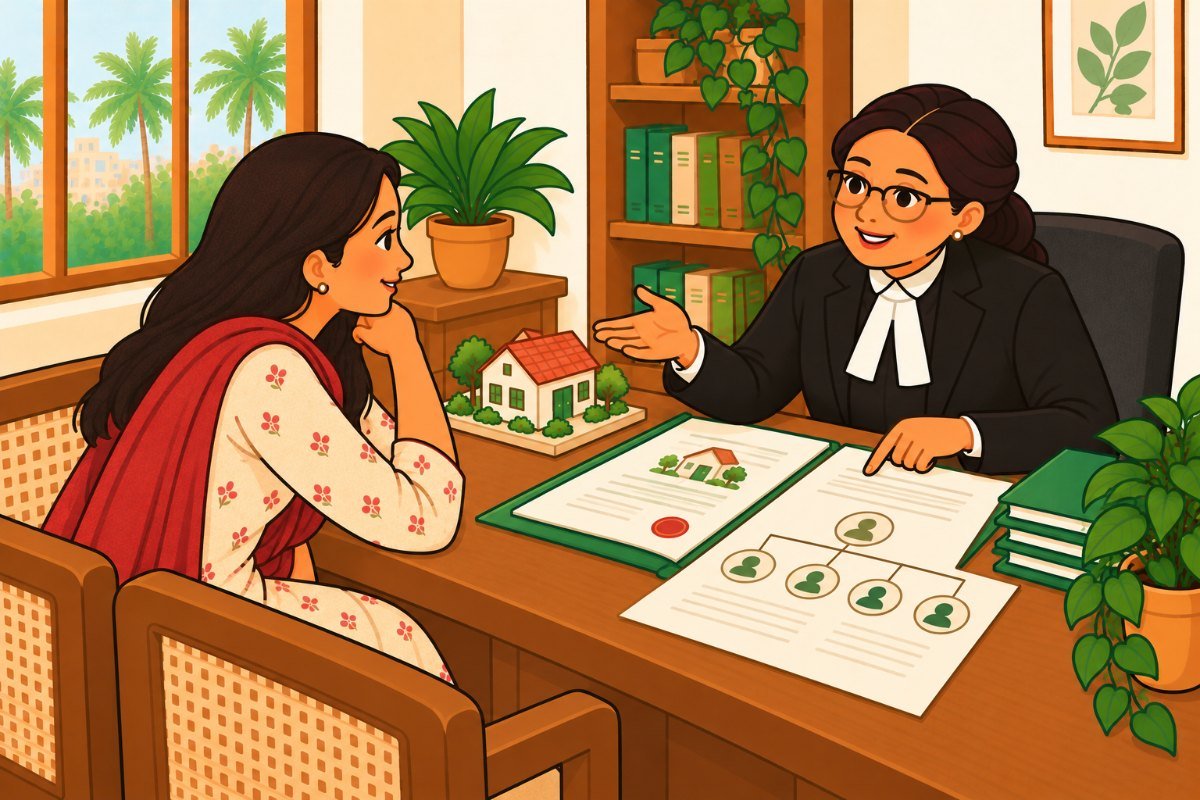
“You are married, the property is your brothers’.” Daughters in Mumbai and across Maharashtra still hear this, and are often asked to sign a release deed without knowing what they are giving up. The law has been clear since 2005, and the Supreme Court settled the remaining doubts in 2020: a daughter in a Hindu family is a coparcener by birth, with the same share in ancestral property as a son, whether she is married or not. This guide explains what that means, what counts as ancestral property, and the practical steps.
Key facts
- Law
- Section 6, Hindu Succession Act, 1956, as amended with effect from 9 September 2005
- Leading case
- Vineeta Sharma v. Rakesh Sharma, Supreme Court, three judges, 11 August 2020
- Married daughters
- Same rights as unmarried daughters and as sons
- Father’s death before 2005
- Does not matter. The right arises by birth
- Who it covers
- Hindus, Sikhs, Jains and Buddhists
What the Supreme Court decided in 2020
In Vineeta Sharma v. Rakesh Sharma, a three-judge bench held that:
- A daughter becomes a coparcener by birth, in her own right, with the same rights and liabilities as a son. This applies to daughters born before or after 2005.
- The father did not need to be alive on 9 September 2005. An earlier judgment that said otherwise was overruled.
- Partitions, sales and wills made before 20 December 2004 are protected and are not reopened.
- A brother cannot defeat her claim by saying the family had an oral partition. A partition is accepted only if it was made by a registered deed or a court decree, or in rare cases where public records clearly show it.
- In partition suits still pending, daughters must be given a share equal to sons, even if a preliminary decree has already been passed.
Ancestral or self-acquired: the question that decides most cases
The daughter’s right by birth applies to coparcenary property, which lawyers usually call ancestral property: property that has come down undivided in the joint family. Not every family home is ancestral in this legal sense.
- Self-acquired property: a flat the father bought with his own earnings. He can sell it, gift it or leave it by will to anyone. If he dies without a will, his daughters, sons, widow and mother inherit equal shares as Class I heirs. A daughter is never excluded because she is married.
- Property inherited from a father after 1956: the Supreme Court held in 1986 (Commissioner of Wealth Tax v. Chander Sen) that what a son inherits from his father under Section 8 of the Act is normally his own property, not joint family property for his children. Whether a particular house is ancestral therefore depends on its history, which is why the documents matter.
- Property gifted or left by will is generally the recipient’s own, unless the gift or will says otherwise.
Either way, a daughter usually has a claim. The difference is whether it arises by birth (ancestral) or only on the parent’s death without a will (self-acquired).
Before you sign a release deed
Families often ask daughters to sign a release (relinquishment) deed in favour of a brother or mother. Once registered, it is very difficult to undo. Before signing:
- Ask for a list of every property: flats, land, shops and society shares, with their 7/12 extracts or property cards and society share certificates.
- Find out whether each property is ancestral or self-acquired, and what your share is worth.
- Read the deed yourself. Check whether you are giving up a share in all properties or only one, and whether any money is being paid to you.
- Do not sign under pressure or at a family function. You are entitled to take time and advice.
A release among close family members is stamped at a concessional rate under the Maharashtra Stamp Act; check the current rate before registration.
Getting your name recorded
- Agricultural land: heirs apply to the Talathi for a heirship mutation (varas nond), which appears as an entry (ferfar) in the mutation register and then on the 7/12 extract. Applications can also be made online through the state’s e-Hakk system.
- Flat in a co-operative society: the society transfers the share on the basis of a will, succession certificate, heirship certificate or family arrangement. A nominee is only a provisional member. See transferring a society flat after a member’s death.
- MHADA flats: see MHADA flat transfer after death.
- If brothers refuse: a partition suit in the civil court decides each person’s share. A legal notice is usually sent first.
Frequently asked questions
My father died in 2001. Do I still have a share?
Yes, in coparcenary property, unless it was partitioned or sold before 20 December 2004 by a registered deed or a court decree. The Supreme Court held that the father did not need to be alive in 2005.
My brother says the property was divided orally years ago.
An oral partition is not accepted as a defence to a daughter’s claim unless public documents clearly show it, according to the 2020 judgment.
Can my father leave everything to my brother by will?
He can leave his self-acquired property, and his own share in coparcenary property, by will. He cannot take away your share by birth in coparcenary property.
I am Muslim. Does this apply to me?
No. Muslim inheritance follows Muslim personal law, under which a daughter generally receives half the share of a son. Christians and Parsis are governed by the Indian Succession Act, 1925.
Consultations are by appointment at the chambers in Malwani MHADA, Malad (West). To fix a time, telephone +91 99301 50560 or send a message on WhatsApp.
General information, not legal advice. Whether a property is ancestral depends on its history and documents.
Related
- Muslim inheritance law: shares, wills and hiba
- Legal heir certificate, succession certificate and probate
- Making a will in Mumbai
- Gift deeds in Maharashtra
- Women and family matters