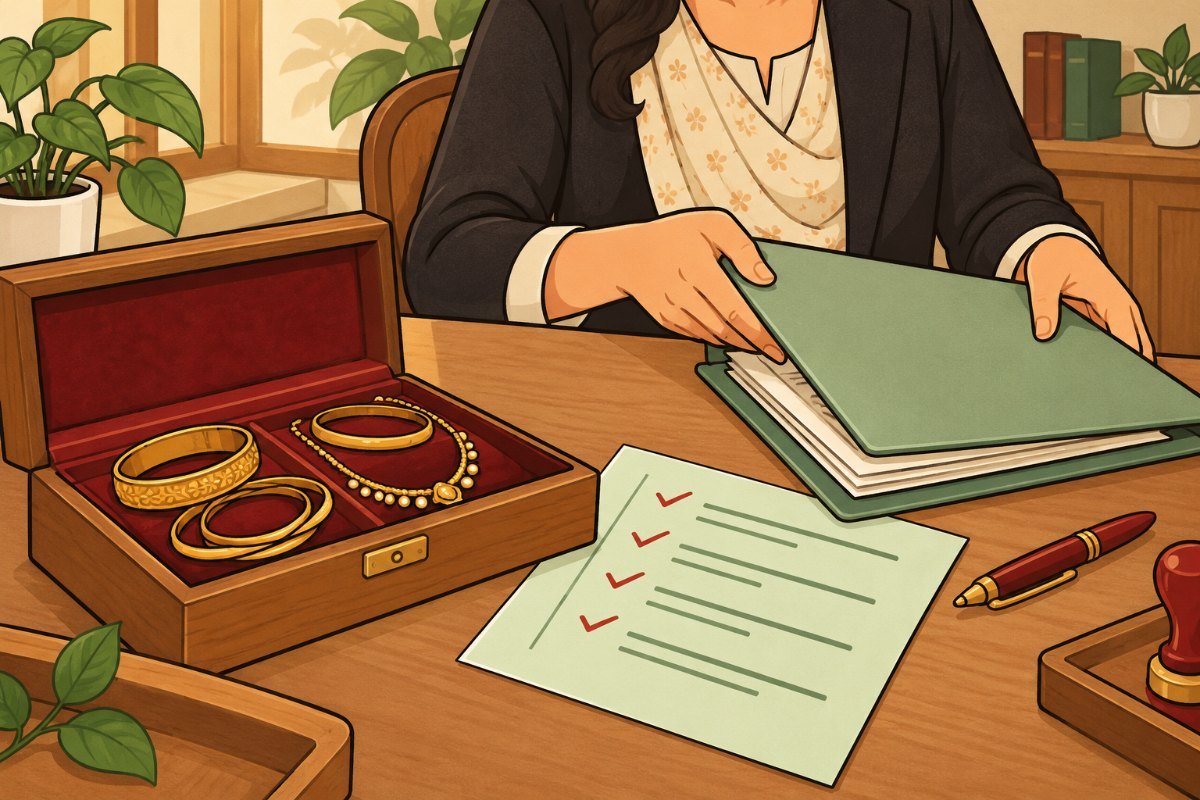
When a marriage breaks down, one of the most common disputes is over the wife’s jewellery, cash and gifts, often kept “for safety” by the husband or his mother. The law is clear that these belong to her. This guide explains what counts as stridhan and how to get it back.
What is stridhan?
Stridhan is property a woman receives before, at or after her marriage, including:
- jewellery and gifts from her parents and relatives at the wedding;
- gifts from the husband and his family, including jewellery given at the wedding or on later occasions;
- cash, fixed deposits or property gifted to her;
- her own earnings and things bought with them.
In Maya Gopinathan v. Anoop S.B. (April 2024), the Supreme Court reiterated that stridhan is the woman’s absolute property. The husband has no control over it; he may use it in distress but is bound to restore it or its value. The Court ordered the husband to pay Rs 25 lakh for gold that had been taken into custody by him and his mother and not returned.
Stridhan and dowry
Dowry is property demanded or given in connection with the marriage, and giving or taking it is an offence. Where dowry has been received by anyone other than the woman, Section 6 of the Dowry Prohibition Act, 1961 requires it to be transferred to her. Gifts given voluntarily to the bride are her stridhan. Either way, she can claim them back.
Ways to recover it
| Route | Forum | When it fits |
|---|---|---|
| Written demand | Letter or legal notice | First step in most cases; creates a record of refusal |
| Domestic Violence Act, Section 19(8) | Magistrate’s court | Where there is domestic violence; the Magistrate can direct return of stridhan or other property |
| Family Court | Family Court, Bandra | Along with divorce, maintenance or a separate claim for return of property |
| Criminal complaint | Police or Magistrate | Where property entrusted to the husband or in-laws is dishonestly kept or disposed of: criminal breach of trust under Section 316 BNS (formerly 406 IPC), often with Section 85 BNS |
The Supreme Court held in Rashmi Kumar v. Mahesh Kumar Bhada (1997) that refusing to return entrusted stridhan is a continuing offence, so a complaint is not barred merely because the jewellery was taken years ago.
Proving it, even without receipts
Few families keep bills for wedding jewellery. Courts know this. In civil and Family Court proceedings, the standard is the preponderance of probabilities, not proof beyond reasonable doubt, as the Supreme Court confirmed in Maya Gopinathan. Useful evidence includes:
- wedding photographs and videos showing the jewellery;
- bills, jeweller’s estimates, or bank withdrawals around the wedding date;
- a list prepared by the family with descriptions and approximate weights;
- messages in which the husband or in-laws admit holding it;
- bank locker records, and witnesses who saw the jewellery handed over.
Step by step
- Make a detailed list: item, weight, who gave it, when, and who is holding it now.
- Collect photographs, bills and any messages.
- Send a written demand or legal notice asking for return within a fixed time.
- If there is no response, choose the route: DV Act application, Family Court petition, or criminal complaint, often in combination.
- Ask the court to record the items returned item by item, with weights, when handed over.
Frequently asked questions
My mother-in-law kept the jewellery in her locker. Is she liable?
Yes. Anyone who was entrusted with the stridhan and refuses to return it can be made to answer for it.
The jewellery was given by my in-laws. Is it still mine?
Gifts made to the bride by the husband’s family at the time of marriage are her stridhan, unless it is shown that they were only given temporarily.
He sold my jewellery. Can I get its value?
Yes. Courts can order payment of its present value, as in Maya Gopinathan, where the value was fixed taking into account the rise in gold prices.
See also: dowry harassment and cruelty, a wife’s rights in divorce and legal notices.
Consultations are by appointment. To fix a time, telephone +91 99301 50560 or send a message on WhatsApp.
This guide describes general law as understood in October 2026. It is not legal advice; take advice on the facts of your case before acting.