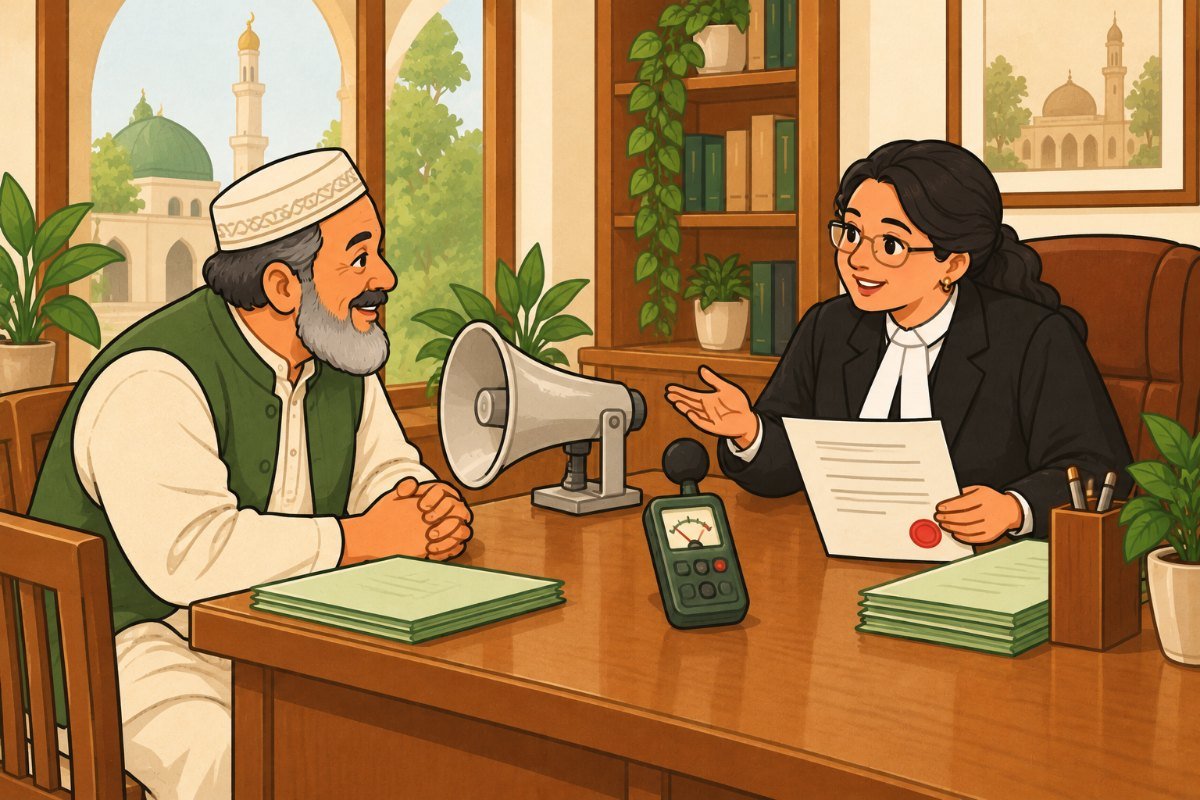
Mumbai is home to temples, mosques, churches, gurudwaras and other places of worship, often side by side. Loudspeakers at all of them are governed by the same law: the Noise Pollution (Regulation and Control) Rules, 2000. This guide explains the rules for trusts and managing committees, and for residents.
The core rules
| Rule | Position |
|---|---|
| Permission | A loudspeaker or public address system needs written permission from the authority (in Mumbai, the police) |
| Hours | Not between 10 pm and 6 am, except in closed premises and on the limited festival days the State notifies (up to midnight) |
| Noise limits | In residential areas, 55 dB(A) by day and 45 dB(A) at night; at a public place’s boundary, a loudspeaker must not exceed the area standard by more than 10 dB(A), or 75 dB(A), whichever is lower |
| Silence zones | Areas within 100 metres of hospitals, educational institutions and courts are protected by stricter limits |
These rules apply equally to every religion and to every kind of use: azaan, aarti, bhajans, kirtans, prayers, sermons and announcements.
The Bombay High Court’s January 2025 ruling
In Jaago Nehru Nagar Residents Welfare Association v. Commissioner of Police (January 2025), the Bombay High Court held that the use of loudspeakers is not an essential part of any religion, so denying permission does not violate the freedom of religion. The Court:
- directed the Mumbai Police to act promptly on complaints about loudspeakers at religious places, without requiring the complainant to disclose their identity;
- suggested a graded response: a caution first, then fines, then seizure of equipment for repeated violations, and cancellation of permission;
- asked police to measure noise using decibel-meter apps; and
- asked the State to consider requiring places of worship of all religions to use sound systems with built-in, calibrated decibel limits.
In 2025, the State also announced in the Assembly that permissions would be time-bound and that the local police inspector would be responsible for enforcement.
For trusts and managing committees
- Obtain written permission from the police, and renew it before it expires.
- Use the loudspeaker only between 6 am and 10 pm. Early-morning calls to prayer and announcements before 6 am cannot be made on loudspeakers.
- Keep the volume within the limits; consider a limiter that caps the decibel level.
- Point speakers inwards, and use indoor sound systems for longer programmes.
- Keep the permission letter on the premises.
Public trusts that manage places of worship are also accountable to the Charity Commissioner for their affairs. See Waqf Board or Charity Commissioner.
For residents
- Note the time, date and duration; a decibel-meter app reading and a short recording help.
- Call 112 or 100, or complain to the local police station. Under the High Court’s ruling, you need not disclose your identity.
- For persistent violations, write to the senior police inspector and then the Deputy Commissioner of Police.
- Keep complaints civil and specific; the law is about noise, not religion.
Frequently asked questions
Can a place of worship use loudspeakers before 6 am during Ramzan or a festival?
The 10 pm to 6 am restriction applies to all religions. Festival relaxations, where notified, only extend use up to midnight; they do not permit early-morning use before 6 am.
Can the police seize a loudspeaker?
Yes. The High Court noted that police can seize offending equipment and cancel permission for repeated violations.
See also: festival loudspeaker relaxation days and procession permissions.
Planning ahead? See the festival permissions calendar 2026–27 for dates and when to start preparing, or all festival guides.
Consultations are by appointment. To fix a time, telephone +91 99301 50560 or send a message on WhatsApp.
This guide describes the law as understood in October 2026. It applies equally to places of worship of all religions. It is not legal advice.
More festival guides
- Festivals in Housing Societies
- Wedding Baraat, Band and DJ in Mumbai
- Chhath Puja in Mumbai
- Religious Procession Permission in Mumbai
- Makar Sankranti Kite Flying
- Holi in Mumbai
- Dahi Handi Rules in Maharashtra
- Navratri Garba and Dandiya Events in Mumbai
- Ganeshotsav Pandal Permission in Mumbai
- New Year and Christmas Parties in Mumbai
- Diwali Firecrackers in Mumbai
- Bakri Eid Qurbani in Mumbai